 When something upsets us, it can feel as if it just happens. A comment, an email, a look, a silence. And suddenly we are anxious, angry, shut down, tearful, defensive, or all of the above.
In those moments, our nervous system is doing its job: protecting us. The trouble is that when we are in threat mode, our mind can become harsh, fast, and convincing. We can jump to conclusions, replay scenes, predict worst case outcomes, or feel a wave of shame that makes no logical sense.
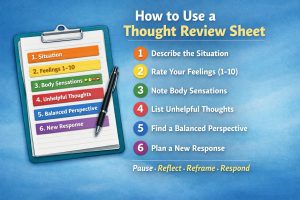
This is why I often use (and send) a Thought Review Sheet to clients. It is a simple worksheet that helps you slow everything down and reflect when you are no longer reacting out of fear or anger. It is not about thinking positive. It is about getting clearer, kinder, and more realistic so you can respond in a way that works for you.
Download the Thought Review Sheet (PDF)
You can download the sheet here and print it, or type into it on your phone or laptop.
Download the Thought Review Sheet (PDF)
When to use it
The Thought Review Sheet is most useful:
- After an argument, awkward conversation, or tense meeting
- When you are replaying something and cannot let it go
- When anxiety spikes and you are not sure why
- When you notice a strong reaction that feels bigger than the situation
- When you want to learn from a moment rather than beat yourself up about it
A helpful rule of thumb is to use it when the intensity has dropped a notch. If you are right in the middle of panic or overwhelm, start by grounding first. For example, slow breathing, a short walk, a drink of water, or feeling your feet on the floor. Then come back to the sheet later.
The six parts of the sheet (and what they are really doing)
1) Describe the situation (what happened?)
Write the basics: where, when, who with, and what was said or done. Try to stick to observable facts, as if a camera recorded it.
Why this helps: Anxiety loves vague statements like ‘It was awful’ or ‘They hate me’. Facts give you something solid to work with.
2) Rate how you feel (out of 10)
Name the emotion or emotions and rate the intensity. For example, anxious 8 out of 10, embarrassed 6 out of 10, angry 7 out of 10, sad 5 out of 10.
Why this helps: Rating creates distance. You are noticing the feeling, not being swallowed by it.
3) Physical symptoms (what did you notice in your body?)
Where did you feel it? What did your body do? For example, tight chest, hot face, shaky legs, clenched jaw, nausea, buzzing in arms.
Why this helps: Emotions live in the body. If we miss this step, we often try to think our way out while our nervous system is still braced for danger.
4) Unhelpful thoughts or images
This is the honest bit. What went through your mind? What did it mean to you? What button did it press?
- ‘I’m failing.’
- ‘They think I’m incompetent.’
- ‘I’ve ruined everything.’
- An image of being rejected, told off, laughed at, or abandoned
Why this helps: Once a thought is on paper, it becomes easier to question. In your head it can feel like a fact.
5) A more balanced, realistic perspective
This is not about arguing with yourself. It is about widening the lens. You might ask:
- Is this fact or opinion?
- What might someone else say?
- What is the bigger picture?
- Is there another way of seeing it?
- What advice would I give someone I care about?
Why this helps: When we are triggered, our mind narrows. A balanced thought reopens possibilities.
6) Reflection (what could I do differently next time?)
This is where change happens. The sheet invites you to consider:
- What would be more effective?
- What will be most helpful for me, or for the situation?
- What will the consequences be?
This is about wise action, not perfect action.
A worked example (short and real life)
Situation: I sent a message to a friend. No reply for two days.
Emotion and intensity: anxious 7 out of 10, rejected 6 out of 10.
Body: tight throat, stomach sinking, restless.
Thoughts and images: ‘They’re fed up with me.’ ‘I’ve said something wrong.’ Image of being left out.
Balanced perspective: ‘I don’t actually know why they haven’t replied. They could be busy, stressed, or they may have missed it. If there is something to clear up, I can do that kindly.’
Reflection and wise action: ‘I will send one gentle follow up and then step back. I will do something grounding tonight rather than checking my phone repeatedly.’
Notice what happens. You move from spiral to choice.
Common pitfalls (so you do not turn it into homework torture)
- Trying to do it right. There is no gold star. This is for you.
- Using it to criticise yourself. The point is understanding, not self judgement.
- Forcing a positive thought. If it does not feel believable, make it smaller and more realistic.
- Skipping the body section. If your body is still in threat mode, your mind will keep returning to the worry.
- Doing it mid argument. Save it for afterwards, when you can reflect.
When a worksheet is not enough
If you are feeling unsafe, experiencing thoughts of harming yourself, or you are in crisis, please reach out for urgent support. In the UK you can contact Samaritans on 116 123, NHS 111, or call 999 in an emergency.
If the sheet brings up trauma memories, flashbacks, or overwhelming shame, it may be something to work through with support rather than alone.
Download the Thought Review Sheet (PDF)
Download the Thought Review Sheet (PDF)