When ‘You’re Too Sensitive’ Becomes Permission to Bully
Being called ‘too sensitive’ is something many people recognise, often from childhood or family life. Watching I’m a Celebrity…Get Me Out of Here! this year, I was struck by how quickly that label can shift attention away from behaviour and onto the person experiencing it. stood out to me
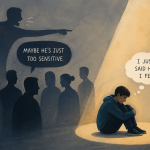 Watching I’m a Celebrity…Get Me Out of Here! this year, something stood out to me. It wasn’t just the conflict itself. It was what happened around it. When David Hayes’ behaviour towards Adam Thomas crossed a line, no one really stepped in to name it. Instead, the focus quietly shifted.
Adam was described as ‘sensitive’. Once that label was in place, the behaviour no longer needed to be looked at in the same way.
How bullying gets enabled
This is something I often notice in therapy. Bullying is rarely just about one person. It sits within a wider system. In the camp, there was a moment where someone could have said, ‘That’s not ok.’ Instead, the narrative became, ‘Maybe he’s just a bit sensitive.’
That shift matters. It allows the behaviour to continue without challenge. Bullying does not need agreement to carry on. It only needs a lack of interruption.
Why ‘too sensitive’ shifts responsibility
Calling someone ‘sensitive’ can sound harmless, even caring. However, in this context it changes where responsibility sits. The attention moves away from the behaviour and onto the person experiencing it.
Instead of asking whether something was hurtful or inappropriate, the question becomes why the person reacted in the way they did. Over time, this can lead someone to doubt their own experience. They may begin to question whether they are overreacting, rather than trusting what they felt.
This is often where anxiety begins to build, especially if someone has learned not to trust their own feelings.
How this shows up in families
I see this dynamic often in families. A child grows up in an environment where one person is critical, unpredictable, or dominating, and others tend to avoid conflict.
The child who reacts becomes known as ‘the sensitive one’. Not the one being hurt, but the one noticing it.
Gradually, they learn that their feelings are too much. Speaking up leads to being dismissed. Over time, it feels safer to stay quiet. This can have a lasting impact on self-esteem. It is not just that they feel hurt in the moment. They begin to believe there is something wrong with them.
Why people don’t speak up
People often ask why no one says anything in these situations. It is rarely because people agree with what is happening. More often, it is about how hard it is to step outside the group dynamic.
There may be a fear of becoming the next target. There may be a wish to keep the peace. Sometimes there is uncertainty about whether what is happening is ‘bad enough’ to challenge.
Even in professional settings, this can happen. There is a long-standing question in our field about whether we sometimes focus more on supporting those affected by harm, rather than addressing the behaviour itself. As has been noted, there can be a tendency towards ‘patching up the casualties’ rather than intervening to stop the harm at source .
What helps to shift the dynamic
A healthier response does not need to be confrontational or dramatic. Often it is about gently bringing the focus back to what is happening.
Naming the behaviour, acknowledging its impact, and slowing things down can be enough to shift things. This is often part of learning how to manage differences and conflict in relationships. It keeps the responsibility where it belongs, rather than moving it onto the person who has been affected.
Rebuilding trust in your own feelings
If you grew up being described as ‘too sensitive’, this may still resonate now. You might find yourself second guessing your reactions, minimising your feelings, or holding back from speaking up.
In counselling, part of the work is to begin to trust your own experience again. Not to become less sensitive, but to recognise that what was labelled as sensitivity may in fact have been awareness.
If you are unsure what counselling might involve, it can help to read more about what to expect from a first session.
A final thought
Bullying does not just continue because of one strong personality. It continues because of what happens around it.
Sometimes the most meaningful change comes from someone noticing, and being willing to say, in a steady and grounded way, ‘That’s not ok.’